 AI Act Register Pilot
Detect your AI by domain
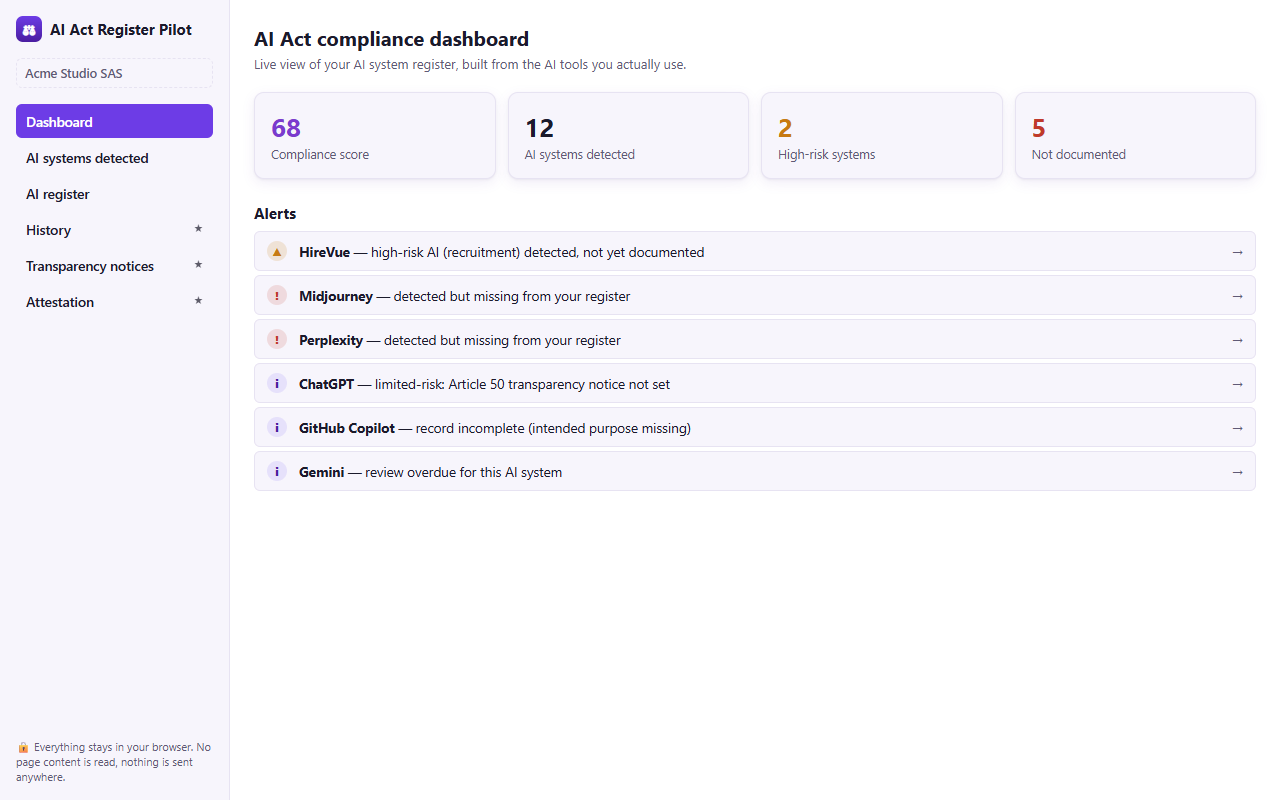
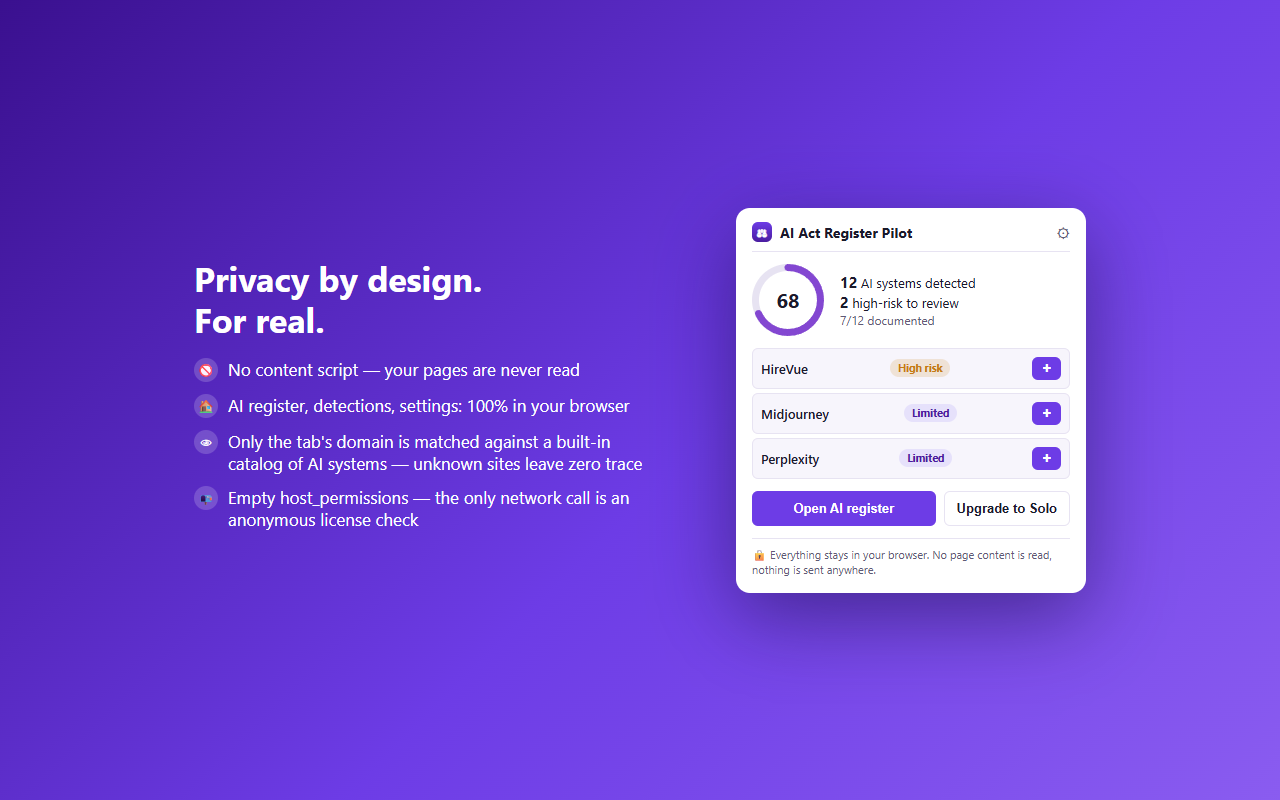
Install and browse normally: the extension maps the AI tools in use locally, by domain name only — never page content, never the URL.
⏳ Article 50 transparency duties apply on 2 August 2026 — soon. High-risk duties (Annex III) apply on 2 August 2027. What you need to prepare
AI Act Register Pilot recognizes the artificial-intelligence tools your team actually uses (by domain, via a built-in catalog), classifies them by EU AI Act risk level — unacceptable, high, limited, minimal — and generates a pre-filled AI system register, with transparency obligations and attestation. 100% local — no page content read, no URL stored, nothing sent.
Early access: the official package installs in five minutes, while the Chrome Web Store listing is under review. How it works · get notified at launch
AI system register · AI Act risk classification · Transparency obligations (Art. 50) · History & attestation · CSV / JSON / PDF exports
How it works
No more AI inventories written from memory and outdated the same day: AI Act Register Pilot starts from the tools your team really uses.
Install and browse normally: the extension maps the AI tools in use locally, by domain name only — never page content, never the URL.
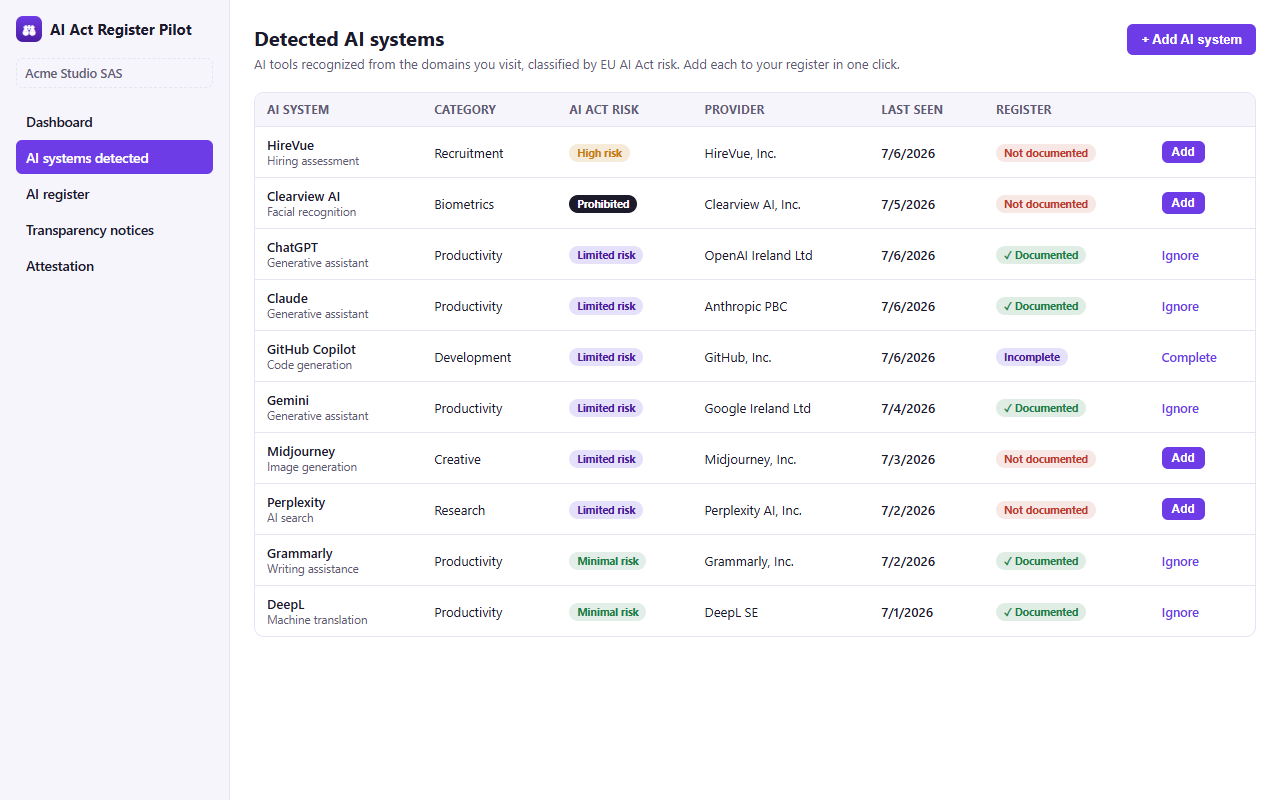
Each tool is mapped to its AI Act risk level — unacceptable, high, limited or minimal — with the associated obligations and its likely role (deployer or provider).
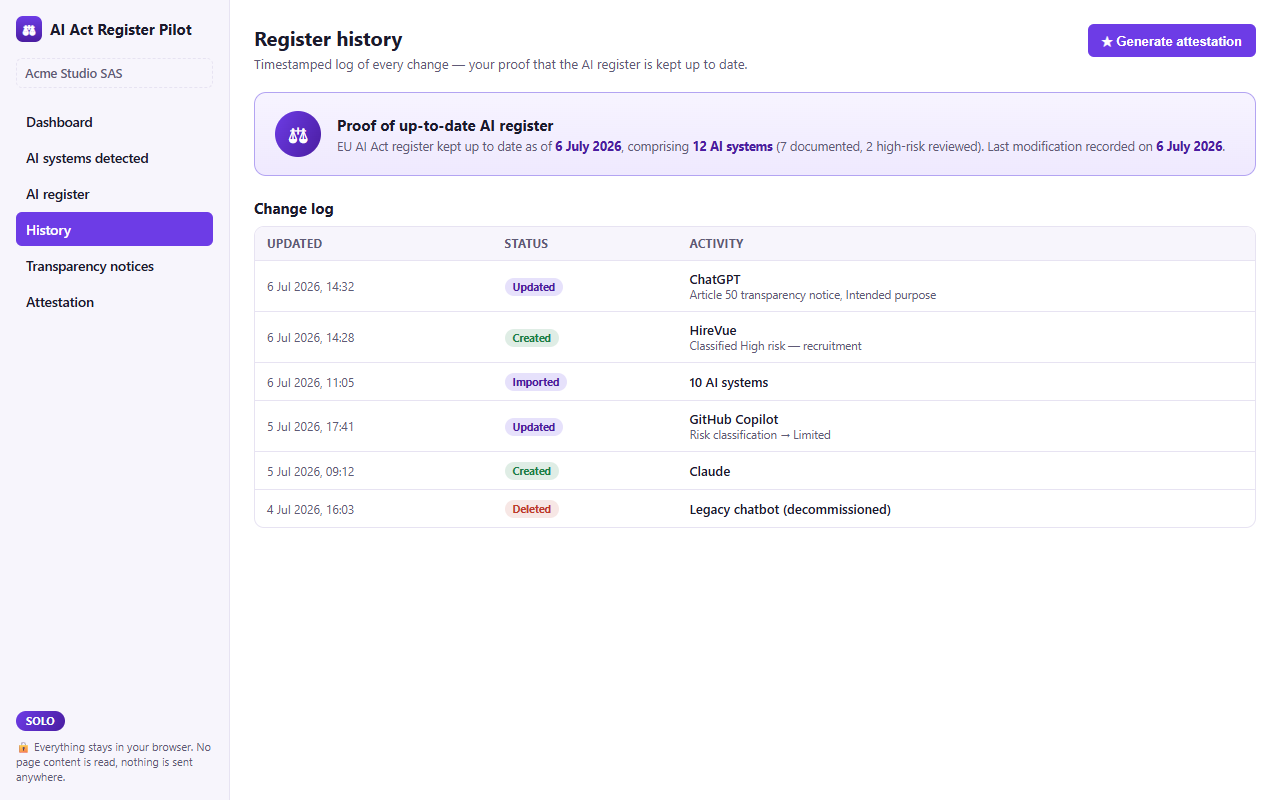
One click: a pre-filled AI system register, transparency obligations (Art. 50), alerts, timestamped history and CSV / JSON / PDF exports ready to present.
Screenshots
What you get
An inventory built from the AI tools actually in use: provider, purpose, category, role (deployer / provider) and suggested risk level. What is an AI system register?
Every system is sorted — unacceptable, high, limited, minimal — following the logic of Regulation (EU) 2024/1689. Understand the 4 levels
Generator for the user-information notices required for chatbots, generative AI and synthetic content. The 2 August 2026 deadline
Undocumented high-risk systems, potentially prohibited practices, deployer → provider shifts: you always know what to address first. Your deployer obligations
Export your register as an inventory or an audit-ready PDF, ready to present to a supervisory authority or an auditor.
Up to 10 organizations and a register with your firm's logo on Agency — built for external DPOs, consultants and firms.
AI Act Register Pilot automatically sorts every detected tool into the Regulation's risk pyramid.
Social scoring, manipulation, prohibited biometrics. Applicable since 2 February 2025.
HR, credit, education, biometrics, essential services: obligations apply on 2 August 2026 (Annex III) and 2 August 2027 (regulated products, Annex I).
Chatbots, generative AI, deepfakes: mandatory user information (Art. 50), applicable on 2 August 2026.
Most tools: good practice recommended, no specific obligation.
An AI compliance tool must be exemplary with your data:
Free template
One row per AI system: provider, purpose, role, risk level, Annex III basis, transparency obligations, human-oversight measures and review date. The exact format the extension fills in automatically.
Free, no strings. One email: the one carrying your files.
Pricing
Free
€0
forever
Solo
€19
per month, cancel anytime — or €190/year
Agency
€49
per month, cancel anytime — or €490/year
FAQ
Regulation (EU) 2024/1689 applies to any organization that develops, places on the market or uses an AI system in the Union — including non-EU companies whose output is used in the EU. Most companies are caught as deployers: they use AI tools built by third parties. See the deployer obligations.
Application is staggered: prohibited practices since 2 February 2025; general-purpose AI (GPAI) obligations since 2 August 2025; the Article 50 transparency duties and the general regime on 2 August 2026; high-risk systems embedded in regulated products (Annex I) on 2 August 2027.
Article 99 sets three caps: €35M or 7% of worldwide annual turnover for a prohibited practice; €15M or 3% for breaching other obligations — including deployer duties and Article 50; €7.5M or 1% for supplying incorrect information to authorities. The higher figure applies, except for SMEs and start-ups where the lower one does. Being unable to produce your AI inventory during an inspection falls into the second category.
The provisional « AI Omnibus » agreement (May 2026) introduces a transition for Article 50(2): generative AI systems already placed on the market before 2 August 2026 would have until 2 December 2026 to satisfy the machine-readable marking requirement for synthetic content. The duty to disclose that a person is interacting with an AI is not postponed. Until the final text appears in the Official Journal, plan for 2 August 2026.
No — not if you are a private company. Article 49 reserves registration in the EU database for providers of Annex III high-risk systems and for deployers that are public authorities, Union institutions, bodies, offices or agencies. A private company that merely uses a high-risk system is not covered. Your register still is the instrument of proof for the duties that do bind you: AI literacy (Art. 4), prohibited practices (Art. 5), deployer obligations (Art. 26), transparency (Art. 50) — and the foundation of an ISO/IEC 42001 or GDPR impact assessment. We would rather tell you than sell you an obligation that does not exist. Read the detail.
A provider develops an AI system or places it on the market under its own name; a deployer uses it under its own authority in a professional context. Most companies are deployers. Heavily customising a system, rebranding it or changing its purpose can flip you into provider status (Article 25), with far heavier obligations — the tool flags this shift.
Systems listed in Annex III and those embedded in already-regulated products (Annex I): recruitment and worker management, access to education, credit scoring, essential services, biometrics, law enforcement, critical infrastructure. They require risk management, data governance, technical documentation, human oversight and registration. See the risk levels in detail.
Never. No content script, no URL stored: only the tab's domain name is compared, in memory, against a built-in catalog of AI tools. Unknown sites leave no trace, and your register, detections and settings stay in your browser. Nothing is sent to a server.
No. AI Act Register Pilot is a mapping and compliance-support tool. The suggested classification is indicative and based on public metadata; the definitive qualification of risk and of your role is yours to make, with your legal counsel where appropriate.
Google Chrome and Chromium-compatible browsers, via the Chrome Web Store, in English and French.
The extension is under review by Google. Leave your email: you will get one message on launch day, and nothing else.
No newsletter, no sales follow-up.